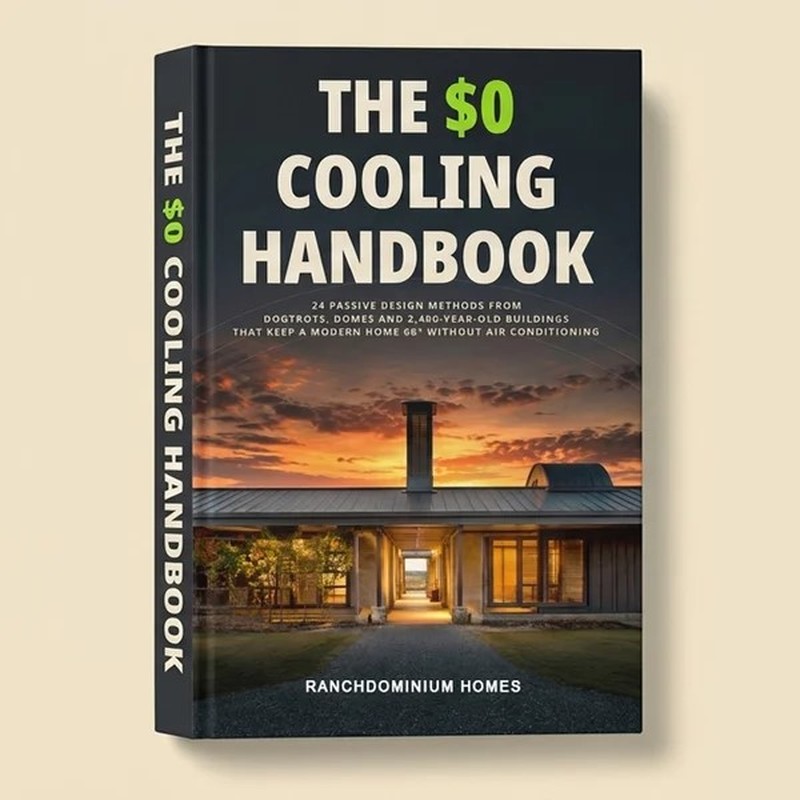
Ranchdominium Homes
Launch promo ends in 00:00:00
Get the Handbook — $27 $17
Ranchdominium Homes ——— Build it cool, not cold

Your house doesn't have a cooling problem. It has a design problem.

Twenty-four passive methods from dogtrots, domes and 2,400-year-old wind towers — each with its cost, its degrees, and the honest limit where it fails. Written by a builder with thirty-one years in places where summer is the enemy.

Instant download · Yours forever

24Passive methods
139Pages
68°Without a compressor
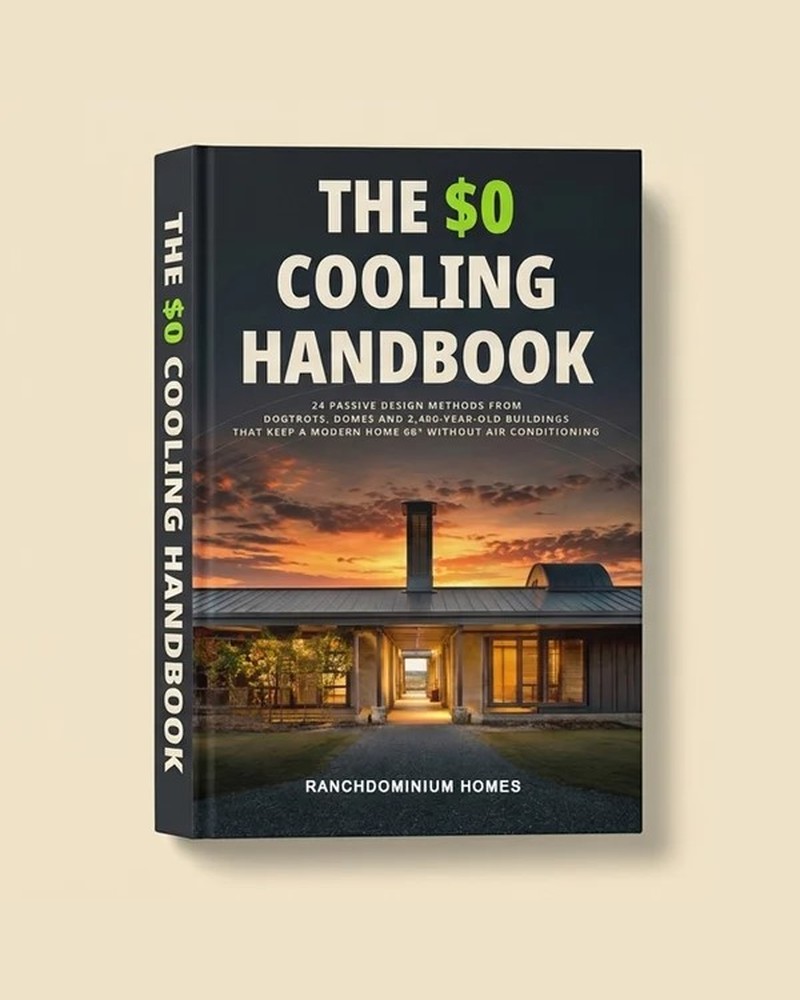
The $0 Cooling Handbook — First Edition

“Heat you never let in costs nothing to remove.”

The only rule worth memorizing
Section I · The Handbook

A building book, not a lifestyle book.

Everything in it is either a measurement, a piece of geometry, or a shopping list.

Silas Warren spent thirty-one years building and repairing houses in places where summer is the enemy — Tucson and Yuma first, then a long stretch on the Gulf Coast, then eleven years consulting on retrofits from Sacramento to Savannah.

Somewhere in the middle of that he got curious enough about the old buildings that he went and stood inside them. The wind towers at Yazd. The vaulted mud roofs at New Gourna. A dogtrot near Natchez that a family had lived in for four generations before anyone on that road had a compressor. He measured what he could measure and wrote down the rest.

“What I found was not romantic. It was arithmetic. Those buildings are cool because somebody understood, without the word for it, that heat arrives by exactly five routes and leaves by exactly four — and that a building is a machine for managing that traffic.” Silas Warren · Before You Begin

When you get the geometry right, the machine runs on nothing. When you get it wrong, you buy a compressor and you feed it for the rest of your life.

So the twenty-four methods in this handbook are not folklore. Each one is a piece of building physics that happens to be old. The physics comes first and the history second, because the history is only useful if you can carry it home and install it.

Every chapter is built on the same six-part frame. At A Glance — a four-cell strip: what it costs, how long it takes, how many degrees it's worth, which climates it suits. The Building — where it comes from and what the original builders were solving. The Physics — why it works, in plain arithmetic, no calculus. The Build — materials with 2026 prices, dimensions, and the order of operations, written the way one person talks another through a job at their elbow. The Honest Limit — what it doesn't do, where it fails, how people install it backwards, and the point at which you stop and call somebody licensed. The Numbers — setup cost, degrees returned, annual dollars, payback.

“I would rather lose a sale than have you dig a trench for a method your county's dew point will defeat.” The 68° Promise, Stated Honestly

That's why three full pages of the front matter are given over to The 68° Promise, Stated Honestly — a plain accounting of what your climate can and cannot deliver, using your city's July diurnal swing, before you have spent a dollar. Albuquerque gets the literal claim. Houston does not, and the book says so on page 15.

Section II · The Difference

You have been paying to remove heat you invited in.

One unshaded four-by-five-foot west window adds as much heat to a room as a 1,000-watt space heater running on high. Most people fight it with a compressor and cover it with a curtain, which does nothing.

The way it's done now

Buy your way out of it
  • Oversize the unit, then feed it every summer for the life of the house
  • Interior blinds and window film — stopping light after the energy has already crossed into the room
  • A powered attic fan bolted onto blocked soffits, pulling makeup air out of your living space
  • Advice with no number attached: "add insulation," "seal it up," "go solar"
  • No baseline, no thermometer, no way to know whether anything you did worked
  • Every fix is a purchase, and every purchase has a power cord

The way the handbook does it

Design it out
  • Name the five paths heat takes in — roof, walls, glass, air leaks, internal loads — and attack the one costing you money
  • Exterior screen, outside the glass, where heat can still convect back to open air. The measured difference is a factor of four
  • Open the soffits and the ridge first, then decide whether you need a fan at all. Chapter 10 has the arithmetic
  • Every method carries its cost in 2026 dollars, its degrees, and its payback
  • Two thermometers, about $25 together, and a ledger to keep score in Appendix B
  • Shade first, then air, then mass — because heat you never let in costs nothing to remove
Section III · What's Inside

Twenty-four methods, stacked in a fixed order.

None of them gets you to a comfortable house alone. They stack — shade first, because heat you never let in costs nothing to remove.

Front Matter

Before Chapter One
  1. The Five Paths Heat Takes Into Your House
  2. The 68° Promise, Stated Honestly
  3. The First Weekend: Three Changes, Eight Degrees
  4. How To Read Me — and the two $25 tools you need first

Part I · Shape

Chapters 1–5
  1. The Dogtrot: The Breezeway That Cooled The American South For Two Hundred Years
  2. The Courtyard: Cooling A House From A Hole In Its Middle
  3. The Long Axis: The Free Rotation That Cuts Cooling Load By A Third
  4. The Dome And The Vault: Why A Curved Roof Runs Cooler Than A Flat One
  5. The Double Roof: The Parasol Method From Queensland To Kerala

Part II · Air

Chapters 6–11
  1. The Windcatcher: Twenty-Four Centuries Of Air Conditioning With No Moving Parts
  2. The Solar Chimney: Building A Stack That Pulls Air All Day
  3. Cross-Ventilation: The Inlet-Outlet Ratio Nobody Teaches
  4. The Night Flush: The Free Method That Does Half The Work
  5. The Cupola, The Ridge, And The Soffit: Making An Attic Breathe
  6. The Mashrabiya: One Screen That Shades, Cools, And Hides

Part III · Mass

Chapters 12–16
  1. Thermal Lag: Making The Afternoon Heat Arrive At Midnight
  2. The Adobe Rule: Wall Thickness As A Clock
  3. The Water Wall: The Cheapest Thermal Mass On Earth
  4. The Earth Berm: Borrowing The Cold Side Of Your Own Yard
  5. The Cool Floor: Why Carpet Costs You Four Degrees

Part IV · Shade

Chapters 17–22 · the longest part
  1. The Overhang: Sizing An Eave With A Pencil And A Latitude
  2. The West Wall Problem: The Hardest Four Hours Of The Day
  3. The Cool Roof: Albedo, Emittance, And A Sixty-Dollar Bucket
  4. The Radiant Barrier: One Roll Of Foil, Twenty Degrees Of Attic
  5. The Exterior Shutter: Why The Screen Belongs Outside The Glass
  6. The Living Screen: Vines, Trees, And Shade That Grows Itself

Part V · Water

Chapters 23–24
  1. The Yakhchāl Principle: Evaporation, Radiation, And Ice In The Desert
  2. The Wet Screen And The Courtyard Fountain: Where Evaporation Works, And Where It Will Ruin Your House

Appendices

The working end of the book
  1. A. The Climate Table — which methods work where
  2. B. The Degree Ledger — the baseline sheet and the per-method entry
  3. C. The Materials And Sourcing Sheet — every material, 2026 prices, and what to substitute
  4. D. Glossary

Figures & panels

How it reads on the page
  1. Line drawings, not photographs — a photo of a wall tells you less than a section through it
  2. Sand boxes with a rust bar for every warning and every limit
  3. Dark cost panels: setup, degrees returned, annual dollars, payback
  4. A sourcing line at the end of each chapter saying where its numbers came from
Get the Handbook — $27 $17

Instant download · Yours forever

Section IV · Reader Results

Real Voices

The book asks you to write down four numbers before you start. These are the notes that come back.

“I did the First Weekend exactly as written. Exterior screen on four west windows, pulled the insulation back off the soffits, box fan in the high window at nine at night. My ceiling went from 96 to 81 on a comparable afternoon. Eighteen years in this house and nobody ever told me my soffits were packed solid.”
Wendell Pike
Wendell Pike62, Prescott AZ
“The Honest Limit section is the reason I trust the rest of it. Every method tells you where it fails before it tells you what it costs. I skipped two chapters because of it and saved myself a trench I would have regretted.”
Roberta Vance
Roberta Vance67, Springfield MO
“Page 15 is where he tells you what your own climate will and will not give you. Gulf South, so half this book is not for me and he says so himself. I did the shade chapters and the radiant barrier. July bill down about forty percent and the upstairs is finally usable.”
Dean Kowalczyk
Dean Kowalczyk59, Gonzales LA
4.9 / 5 stars · from readers of the first edition
The $0 Cooling Handbook, first edition
Section V · About

Ranchdominium Homes

We build and document single-story homes for hot country — long, low, metal-roofed houses on open land, where the sun is the largest thing on the site plan and the electric bill follows the roof.

Everything we publish starts from the same conviction: a house is a machine for managing heat, and most American houses are badly tuned machines that people pay to run anyway. Comfort is a design decision, and it gets made once — on paper, or on the west elevation, or on a Saturday with a roll of screen.

The $0 Cooling Handbook is our first edition, written by Silas Warren and published under Dry Season Press. Thirty-one years of building in Tucson, Yuma and the Gulf Coast; eleven more consulting on retrofits from Sacramento to Savannah; and a lot of time standing inside old buildings with a thermometer, finding out why they work.

“For the builders who never once asked the grid for permission, and for everyone still paying for a problem they can design away.” Dedication
Silas WarrenWritten between Tucson and Baton Rouge · 2026
Section VI · Order

One weekend, under $125, and the book has paid for itself before Part I.

First Edition · 2026

The $0 Cooling Handbook

24 passive design methods · 139 pages · instant PDF download

  • The complete 139-page handbook — all 24 methods, five parts, front matter and appendices
  • Cost, degrees, and payback for every method — the At A Glance strip and the dark Numbers panel in each chapter
  • The Honest Limit sections — where each method fails, and when to stop and call somebody licensed
  • The First Weekend plan — three changes, $40–$125, six to ten degrees off the peak
  • The 68° Promise, Stated Honestly — what your climate's diurnal swing will and won't deliver
  • Appendix A · The Climate Table — which methods work where
  • Appendix B · The Degree Ledger — baseline sheet, per-method entry, season summary
  • Appendix C · Materials & Sourcing — every material, 2026 prices, substitutes, no brand deals
  • Author's line drawings throughout — sections and details, not photographs
$27$17 Launch promo · save $10
Get the Handbook — $27 $17

Instant download · Yours forever

Secure checkout via Gumroad · Visa · Mastercard · Amex · PayPal
Section VII · Questions

Before you buy.

Is 68 degrees without air conditioning a real claim?

It is a real number with a climate attached, and the book spends three pages saying exactly where it holds. In a dry climate with a large day-to-night swing — 25 degrees or more — the stacked methods will hold a well-built house between 68 and 74 degrees through a 100-degree afternoon with no compressor running. That is the desert Southwest, the intermountain West, inland California, the high plains.

In a swing of 18 to 25 degrees you hold the low 70s overnight and the high 70s at four in the afternoon. Under 18 degrees with high humidity, the mass and night-flush half of the book loses most of its power, and the honest expectation is cutting cooling load by 40 to 65 percent — a real and large result, but not 68 degrees in August in Louisiana. You get that accounting on page 15, before you have spent a dollar.

Your videos are free — why buy the handbook?

A video shows you a method. It cannot hand you the eave-sizing arithmetic for your latitude, the inlet-outlet ratio, the 2026 price of perforated radiant barrier per square foot, or the paragraph telling you the four climates where the method backfires.

The handbook is the working document — measurements, geometry, and shopping lists in the order you do them, plus a ledger to keep score. It's what you carry into the attic, not what you watch on the couch.

Does this only work if I'm building new?

No. Fourteen of the twenty-four methods are retrofits you can do to a standard American stick-framed house with a pitched roof and an attic. Six are landscape or exterior work. Four are only practical during new construction or a gut renovation, and those are marked clearly in the At A Glance strip on the chapter's first page so you don't read three pages before finding out.

The dogtrot chapter is not asking you to build a dogtrot. It's asking you to understand what the breezeway was doing, and to reproduce that pressure difference with two windows and a hallway you already own.

Why only $17?

Because the book's own arithmetic makes the price silly to argue about. The First Weekend costs $40 to $125 in materials and typically takes six to ten degrees off the peak indoor temperature, with a first-season bill reduction in the $120 to $400 range. A handbook that pays for itself in the first afternoon should not be priced like a course.

$17 is the launch price for the first edition. It goes back to $27 when the promo ends.

What format is it, and how do I get it?

A single PDF, 139 pages, delivered instantly through Gumroad after checkout. It opens on any phone, tablet, laptop or e-reader, and it prints cleanly if you'd rather have it on paper in the attic. Yours forever, no subscription.

Do I need tools or a contractor to start?

Two thermometers, about $25 together: an infrared gun from any auto parts store, and a cheap indoor-outdoor unit with a min-max memory. That is what Chapter One assumes you own.

Several methods do involve work at height, confined attic spaces, structural loads, below-grade waterproofing, or electrical circuits. The book marks those plainly and tells you where to stop and hire a licensed professional. Codes and permit requirements vary by jurisdiction — verify yours before beginning any work.

Get the Handbook — $27 $17

Instant download · Yours forever

The $0 Cooling Handbook
Wait — one thing

Less than one box fan.

The First Weekend in this handbook costs $40 to $125 in materials and typically takes six to ten degrees off your peak indoor temperature. The book itself is $17 during launch.

Get the Handbook — $27 $17
or see what's inside →